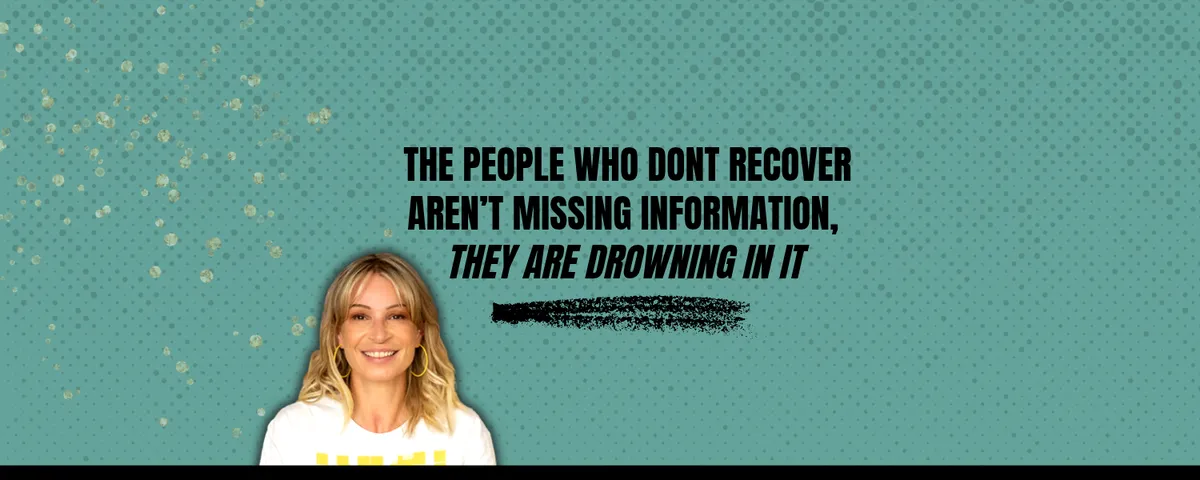
The People Who Don't Recover Aren't Missing Information, They are Drowning In It
I want to talk about something I see again and again in my work. It isn't always comfortable to say out loud, but I think it needs saying.
The people who don't recover usually aren't short of information. They're drowning in it.
Does this sound familiar?
You feel a twinge in your chest and you're straight on Google.
You ask ChatGPT whether it's normal to feel this tired, or why you woke up anxious again.
You read one more forum thread at midnight. Just in case.
You look for meaning in every slight sensation, never quite trusting the information you already have, always wondering if there must be something else.
You already know the answer. You check anyway.
I understand why. When you feel awful and nobody has given you a clear answer, searching feels like taking control. Like if you could just find the right piece of information, you'd finally be able to relax.
What your nervous system hears
But your nervous system doesn't hear "I'm researching."
It hears "I'm still under threat."
Every search, every body scan, every "what does this mean?" sends it the same message: something's wrong. Keep watching.
And a system that's watching for danger will find it. That's its job. So the twinge gets louder. The worry gets bigger. And you're back on Google, looking for reassurance that never quite lands.
Over time, the checking becomes part of what keeps the symptoms going. When I explain this, many people nod, agree, and carry on doing exactly the same thing.
Why I say it straight
I know this might sound harsh. It isn't.
I've been exactly where you are. Checking, researching, convinced the next answer would fix everything. I know how convincing that loop feels from the inside.
If I reassured every fear, I'd be keeping you stuck. And that's not what anyone comes to me for.
I can give someone all the advice and all the techniques in the world. But if they can't absorb that information and act on it, they don't recover. Often they get worse.
The question I ask first
That's why, before I start working with anyone, I ask them directly:
Are you willing to change what you're currently doing?
Whatever that might be. Some people aren't ready yet, and that's OK. I can usually tell.
Others say yes and genuinely mean it. But when the next twinge comes, the habit wins. And then I'm limited in how much I can help, because all the techniques in the world can't help if nothing changes.
I know it isn't easy to stop something you've been doing for months, or even years. But if nothing changes, nothing changes.
I'm not asking for overnight change
I'm not expecting anyone to flip a switch. I'm looking for tiny shifts in behaviour and mindset. That's all.
It might look like:
Noticing the urge to search, and waiting
Closing the tab
Going back to what you already know, instead of looking for a new answer
Telling yourself: that's a twinge, not a threat
Those shifts are what I'm watching for. Because when they happen, I know the changes in symptoms will come.
Where trust comes in
When the behaviour shifts, the symptoms follow. Not immediately. But they do.
And that's where trust comes in. The next time a twinge happens (and it will), the work is to reach for the process, not for Google.
Every time you do, your body learns it's safe enough not to check.
That's how recovery builds. Not from finding the perfect piece of information, but from finally letting the information you already have do its work.
If you saw yourself in this
You're not failing. You're in a pattern, and patterns can change.
A good place to start is The Regulation Trap, my free 10-minute pattern spotter. It'll help you see which patterns might be keeping your nervous system on high alert, so you know where to focus first.


